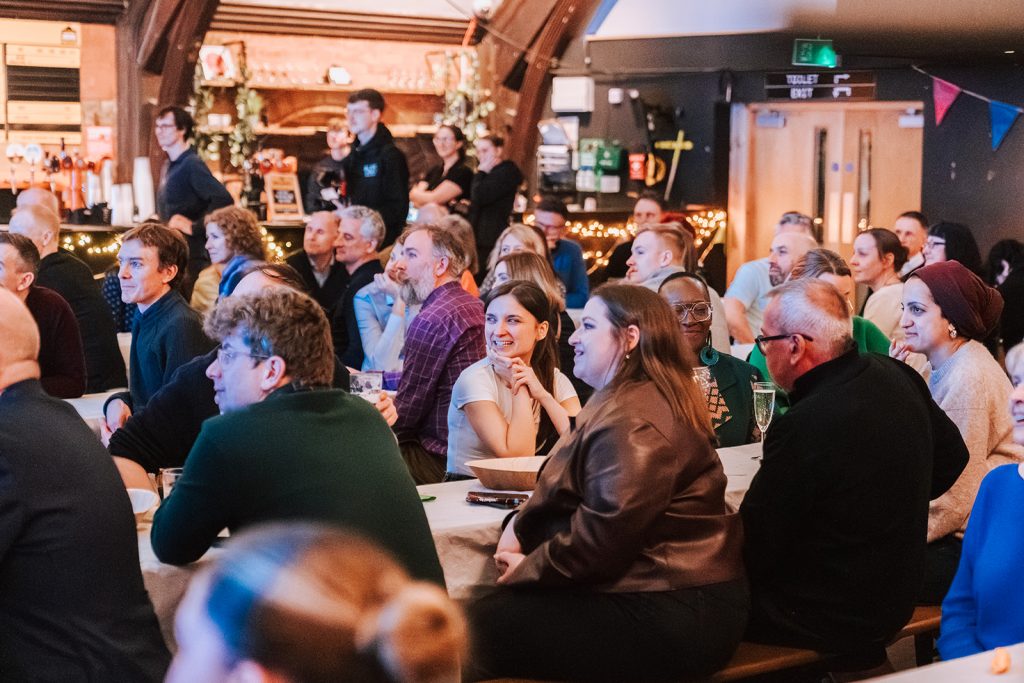
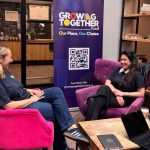
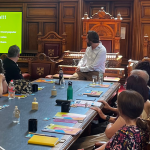
In early March, over 200 people came together in Grimsby for Open House – two days built around a single idea: that lasting change in a place happens when people come together with shared purpose, and keep coming back.
The room reflected that ambition. Attendees came from community organisations, local businesses, the NHS, national foundations, central government, social investors, universities and local councils. People travelled from across the town and across the UK. The event was hosted at Blundell Park, the home of Grimsby Town FC and Docks Beers, with visits to Horizon Youth Zone, the CARE Hub, CATCH and Victoria Street. Those choices of venue were deliberate. This is work rooted in place and the positive change underway in the town.
A Space That Took Years to Build
Speakers returned repeatedly to something that is easy to overlook: the space itself. Not a room or a venue, but the conditions that have been created over four years of patient work – getting people together, holding that space consistently, and allowing the relationships that are the foundation of everything else to develop at their own pace.
That consistency is rare. And several speakers were direct about how significant it is. When people trust each other, ideas move differently. Collaboration becomes possible that wouldn’t otherwise happen. The momentum that is now visible in Grimsby – in its buildings, its organisations, its ambition – did not arrive suddenly. It accumulated.
As one speaker put it: “This model is sustainable when we weave this together so tightly that it can never be undone.” That is the goal. Not a programme with a start and end date, but something woven into the fabric of a place – the whole becoming greater than the sum of its parts.
Mutuality at the Heart of It
A recurring theme across both days was mutuality – the idea that this work only holds if it runs in both directions. Business backing a town, and a town backing its businesses. A town proud of its football club, and a football club proud of its town. Funders and communities in genuine relationship, not transaction.
This is not a soft idea. It has practical consequences. When a local business leader at Open House heard about the difficulties facing care leavers in finding work, he drove to see a contact running a major food processing business in Grimsby and arranged roles for around eight young people through the YMCA. That connection – fast, direct, rooted in trust is what this work tries to make more likely. Not by designing programmes around it, but by putting the right people in the same room and letting relationships do what relationships do.
The workshop on high streets made a similar point through data: community-run businesses retain 56p in every pound locally, compared to 41p for nationally-run businesses. The economics of a place are shaped by whether people feel enough connection to it to spend and invest locally. Mutuality is not just a value. It is a mechanism.
Quality as an Act of Respect
Two of the fringe visits, to Horizon Youth Zone and the CARE Hub generated some of the most significant conversations of the two days. Both buildings are new. Both are beautiful. And that is entirely the point.
These are not functional spaces built to a minimum standard. They are places designed with care, built with the belief that the people who use them deserve quality, that the quality of a space communicates something about how much you value the people inside it. Several attendees spoke about the effect of walking into both buildings. What they described was not just admiration for the architecture. It was the feeling of being in a place that cares for people.
That is a thread running through the broader Our Future approach. The belief that places and people should be treated with respect is not incidental to the model. It is central to it.
The Power of Believing – and Saying So
One of the clearest practical points to emerge from Open House was this: we need to be intentional about talking about what is going well.
This is not about ignoring difficulty. Grimsby has real challenges, and nobody in the room was pretending otherwise. But there is a discipline in choosing to name and celebrate progress, because the story a place tells about itself, shapes what people believe is possible there. Belief is not just a feeling. It drives investment, attracts talent and sustains the effort of the people already doing the work.
Mark Webb opened the event by setting out three qualities he identified in Grimsby: growth, grit and opportunity. The infrastructure projects becoming visible across the town. The resilience of its community leaders. The alignment of public and private investment with local ambition. His message was that this is real and that making the most of it requires everyone to play their part, including in how they talk about the place.
A Model for Elsewhere
The Our Future approach is now being explored in other places. Work with Rochdale A.F.C. and the For Generations To Come movement is one early example. The ambition is not to export a template but to demonstrate something: that patient, relationship-led, locally accountable change is possible, and that it produces results.
Central to that model is the link between a collective working in the common good and the funding structures needed to sustain it. In Grimsby, that is taking shape through the Grimsby Fund – designed not as a spending programme but as a long-term, locally accountable vehicle that can steward investment, back the priorities that local people have identified and attract further public, philanthropic and social finance over time. The £20m Pride in Place funding is the starting point, not the ceiling. What makes it different is that the decisions about how it is used sit with the community, not with a funder or a government department. The fund and the collective reinforce each other: one provides the resources, the other provides the legitimacy and the relationships that make those resources go further.
Open House is in many ways an exemplar of how we could all work together. It is where people doing this work – in Grimsby and beyond – find each other, compare notes and leave with a renewed sense of what is possible when a place decides to believe in itself. We are hugely grateful to everyone who committed two days of their time and threw themselves wholeheartedly into it. It is a genuine joy to work alongside you.
If you are not yet involved but would like to be, please do join the Our Future LinkedIn group or get in touch directly. We would love to collaborate with you.